The Farmhouse
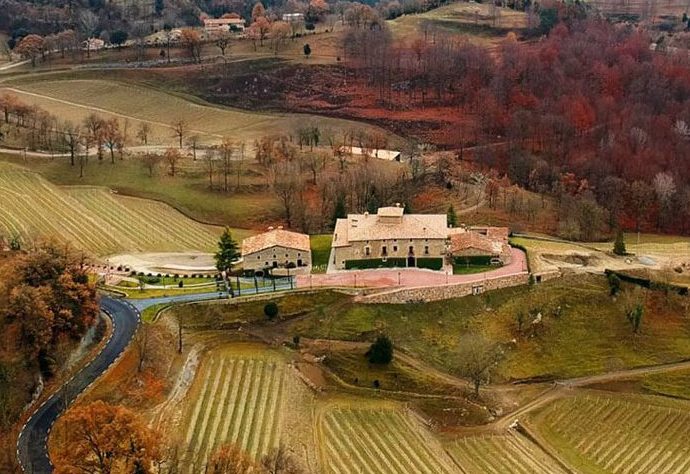
A millennial farmhouse that has endured wars, earthquakes, moments of abandonment, reconstructions, and rehabilitations. A farmhouse steeped in history.
Birth and Transformations

In the late 9th century, among the eroded granite ridges embracing the picturesque town of Santa Maria de Besora, the structure of what would soon become the first Mas Pujolons was born. The surrounding forests were cleared to make way for the first cultivated plots, which in turn gave life to the first fields of wheat, barley, and vines.
It is the monks of the Santa Maria parish and the counts of the Besora castle who, in 1245, praised the prominence of the farmhouse in the first historical documents referring to it, while highlighting the influence of the family that occupied it.
But the passage of time was not kind to its original structure, and transformations have been numerous over the centuries. Little of the original farmhouse remains today.
The most significant transformation dates back to 1657. In a period of abundance and expansion, an enlargement was made that doubled the living space and constructed the current square layout and an imposing central dome with a skylight. The rooms of the house were also enlarged, and a large vaulted stable was added. These latter farmhouse works are attributed to Josep Morató, master builder and architect from the lineage of Arnau Maraut, a well-known family of architects and sculptors from the French Béarn settled in Catalonia.
The second major transformation took place in 1846, with an extension and reconstruction of the caretakers' house, while the upper floor of the main house was converted into a primary school. In 1892, a chapel was added, and a wide courtyard was built over the threshing floor.
Recently, Brad and Teresa, with great care and meticulousness, have carried out a comprehensive rehabilitation of Mas Clarella, successfully restoring its lost majesty.
The Portico and the Door Knocker
In the 15th century, Catalonia was shaken by a devastating earthquake that struck on February 2, 1428, Candlemas day, causing hundreds of deaths throughout Catalonia. Houses and churches were swallowed by the earth on a desolate day. Like many other families, the Pujolons were forced to rebuild part of their farmhouse in the wake of the tragedy.
Shortly after, this farmhouse would be baptized as Mas Clarella, as a result of the marriage between the eldest daughter of the Pujolons family and Jaume Clarella, a trusted day laborer of the masters.
However, the first significant transformation of the farmhouse's structure occurred in the mid-17th century. For the Clarella family, this was an era of great productivity. In 1657, all this increase in production caused the farmhouse to also triple its size.
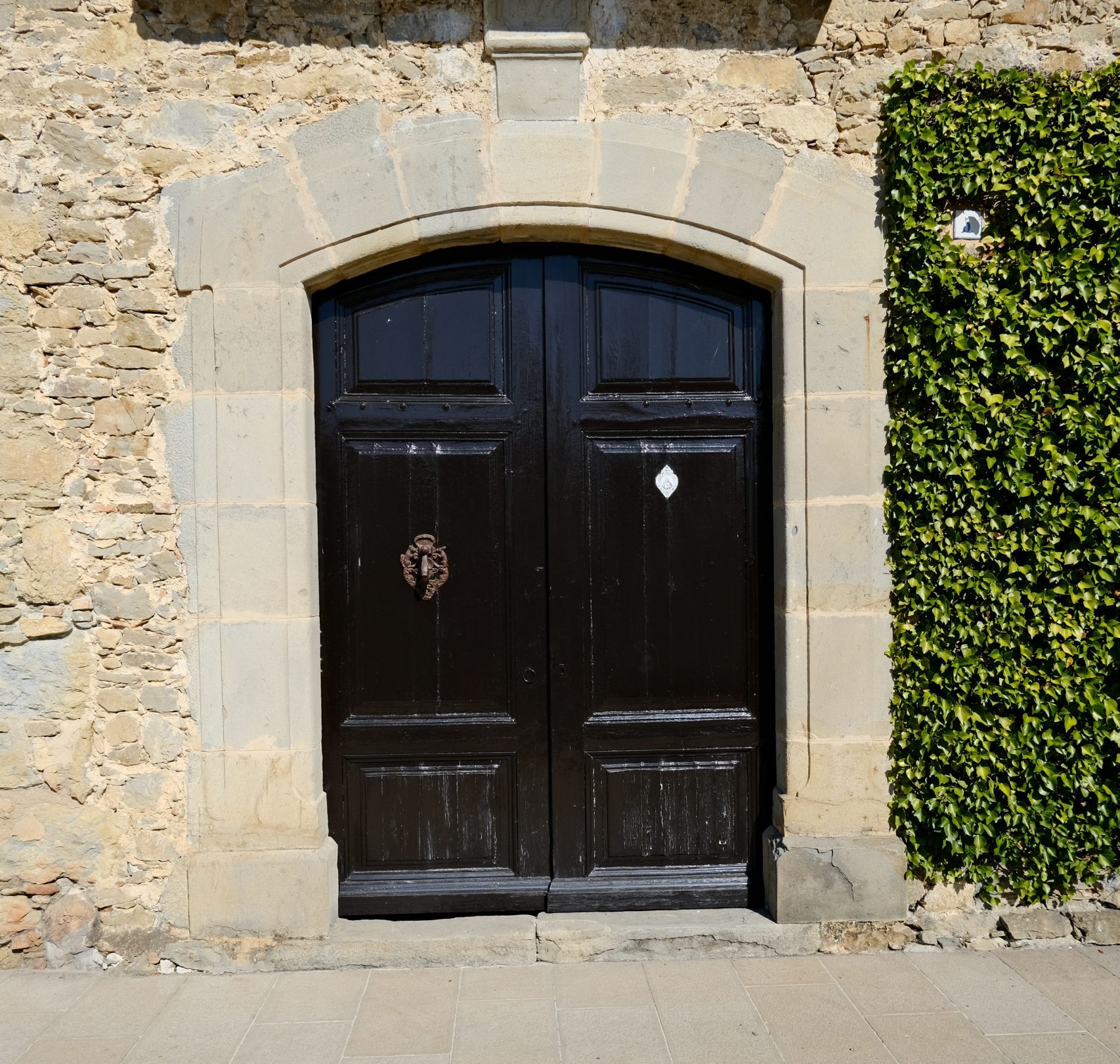
Today, among all the wines produced in the Mas Clarella cellar, one of the signature varieties is the Riesling. Its label features the door knocker of the main door opening to the south. This wrought-iron piece, used to request entry to the farmhouse for over three centuries, today illustrates one of the wines that recount the grandeur of Mas Clarella.
The Arches
Over the centuries, the human essence has been imprinted on every stone and corner of the lands and walls of Mas Clarella; from the meticulously aligned terraces embracing its surroundings, where cereals, vines, and olive trees have been cultivated for generations, to the elegant details of skylights, arches, and portals that have protected and welcomed the generations of people who have lived there.
In 1892, a chapel dedicated to the Virgin of the Rosary was erected, attached to the main building with direct access from the home itself, blessed by the Archbishop of Rome. Access to this sanctuary was gained through a terrace of beautiful arches overlooking the interior of the house.
Today, these very arches, as an emblem of the beauty embodied by Mas Clarella, accompany one of the most exquisite wines produced in this corner of the world: the Pinot Noir, a variety of French origin. This red wine invites us to admire the sweet views contemplated from its arches, to recall the moments of placidity that so many have enjoyed from this viewpoint, and to acknowledge the spiritual refuge the Rosary chapel has provided over the years.